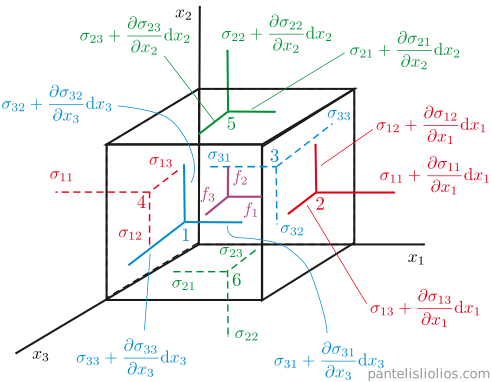
A solid body is in static equilibrium when the resultant force and the resultant moment about every axis are zero. Applied to every part of the body, these conditions lead to the equilibrium equations. In this article we first derive the equilibrium equations from the equilibrium of an infinitesimal element and then, more elegantly, from the equilibrium of an arbitrary volume with the divergence theorem. Both approaches also show that the stress tensor is symmetric.
In this article tensile stresses are taken as positive: a positive stress component acts in the positive coordinate direction on a face whose outward normal points in a positive coordinate direction. In geomechanics the opposite convention, with compressive stresses positive, is often used (see Mohr’s circle); all stress terms then change sign and the equilibrium equations become σji,j=fi instead of Eq. (5).
Equilibrium of forces
Surface and body forces act on a solid body in static equilibrium. We cut an infinitesimal parallelepiped (element) inside the body and analyze the forces that act on it, as shown in Fig. 1. We assume that the stress field is continuous and differentiable inside the whole body.
Figure 1: Infinitesimal parallelepiped representing a point in a body under static equilibrium. The stresses acting on opposite faces of the element are slightly different.
The stress components on each face of the element are functions of the position, since the stress field is non-uniform but continuous. For example, on face 4 the normal stress is σ11(x1,x2,x3)=σ11. On the opposite face 2 the normal stress is σ11(x1+dx1,x2,x3). Using a first-order Taylor expansion we may write:
σ11(x1+dx1,x2,x3)=σ11+∂x1∂σ11dx1(1)
where the higher-order terms have been omitted because they vanish in the limit dx1→0. We follow the same procedure for all the components, as shown in Fig. 1.
Equilibrium of the element requires that the resultant force is zero. By summing up the forces parallel to the axis x1 we get:
where dx1, dx2 and dx3 are the dimensions of the element and f1 is the component of the body force parallel to x1. The body force fi is a force per unit volume; for example, the weight of a material with density ρ is fi=(0,0,−ρg) when the axis x3 points upwards. By dividing by dx1dx2dx3 we get:
∂x1∂σ11+∂x2∂σ21+∂x3∂σ31+f1=0(3)
Similarly, we can obtain the equations for the other two directions. The final set of equilibrium equations is:
By using index notation we may write the three equilibrium equations in compact form:
σji,j+fi=0(5)
Symmetry of the stress tensor
The resultant moment about each axis must also vanish. We take moments about an axis parallel to x3 through the corner of the element where faces 3, 4 and 6 meet, i.e. through the point (x1,x2,x3), with counterclockwise moments (seen from the positive x3 axis) taken as positive. By taking into account all the forces that contribute to the moment about this axis we may write:
and by taking the limit dx1→0, dx2→0 and dx3→0 only the first two terms remain:
σ12=σ21(8)
Following the same procedure for the other two axes leads to the conclusion that the stress tensor is symmetric:
σij=σji(9)
Because of the symmetry, the equilibrium equations (5) may also be written as σij,j+fi=0 or, in vector form, ∇⋅σ+f=0.
It should be noted that the above symmetry holds only if there are no distributed body couples (moments per unit volume), as in Cosserat (polar) continua. Otherwise, the stress tensor is in general not symmetric. However, in most rock mechanics problems the stress tensor is symmetric.
Derivation with the divergence theorem
The same results may be obtained more elegantly by considering an arbitrary volume V of the body, bounded by the surface S with outward unit normal nj. The stress vector Ti acting on the surface is given by Cauchy’s formula:
Ti=σjinj(10)
since, according to Fig. 1, σji is the stress component acting in the direction xi on the face whose normal is parallel to xj. We will also need the divergence theorem (Gauss’s theorem), which transforms an integral over the surface S into an integral over the volume V. For any continuous and differentiable field g:
∫SgnjdS=∫Vg,jdV(11)
where g may also carry other indices, for example g=σji.
Equilibrium of forces
The resultant of the surface and body forces acting on the volume must vanish:
∫STidS+∫VfidV=0(12)
By substituting Cauchy’s formula (10) and applying the divergence theorem (11) to the surface integral we get:
∫SσjinjdS+∫VfidV=∫V(σji,j+fi)dV=0(13)
∫SσjinjdS+∫VfidV=∫V(σji,j+fi)dV=0(13)
This must hold for every volume V inside the body, no matter how small. Since the integrand is continuous, it must vanish at every point, which gives the equilibrium equations (5):
σji,j+fi=0(14)
Equilibrium of moments
The moment of a force Fk acting at the point xj about the origin is the cross product εijkxjFk, where εijk is the permutation symbol. The resultant moment of the surface and body forces must vanish:
∫SεijkxjTkdS+∫VεijkxjfkdV=0(15)
By substituting Tk=σlknl and applying the divergence theorem with g=xjσlk, the surface integral becomes:
which is the symmetry of the stress tensor, Eq. (9).
Two-dimensional problems
When the stresses do not depend on x3 and σ13=σ23=0, f3=0, as in plane stress and plane strain, the third equilibrium equation is satisfied identically and the first two simplify as follows:
where the stresses are in kPa and the coordinates in m. The body is in static equilibrium and the only body force is its weight. Taking the acceleration of gravity as g≈10m/s2, estimate the density of the material and the direction of the acceleration of gravity.
Solution
First we calculate the body forces from the equilibrium equations. Since the stress tensor is symmetric, σ21=σ12, σ31=σ13 and σ32=σ23. By using Eqs. (4) we get:
The body force is constant, as expected for the weight of a homogeneous material. The weight per unit volume is fi=ρgi, where gi is the acceleration of gravity, whose magnitude is g. Thus, the magnitude of the body force is the unit weight of the material: