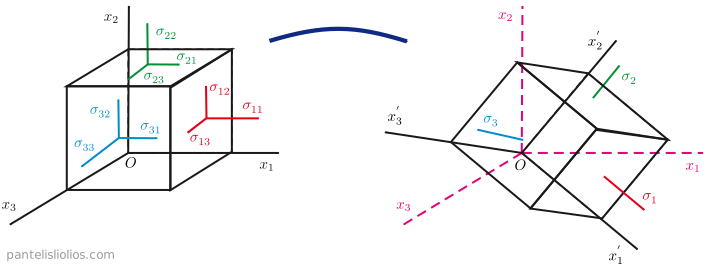
In this article we will discuss the derivation of the principal stresses and the stress invariants from the Cauchy stress tensor. The principal stresses and the stress invariants are important parameters that are used in failure criteria, plasticity, Mohr’s circle, etc.
For every point inside a body under static equilibrium there are at least three mutually perpendicular planes, called the principal planes, where the stress vector is normal to the plane and there is no shear component (see also: Calculation of normal and shear stress on a plane). The normal stresses acting on these planes are called principal stresses. From the mathematical point of view, the derivation of the principal stresses and their directions is a problem of determining the eigenvalues and the corresponding eigenvectors of a symmetric matrix. Fig. 1 illustrates the principal stresses and their directions for a point inside the body, compared to the initial coordinate system and the stress tensor.
Figure 1: Principal stresses and their direction with respect to the initial coordinate system.
On a principal plane with unit normal ni, the stress vector is parallel to the normal, i.e. Ti=σni, where σ is the normal stress on the plane. Combined with Cauchy’s formula, Ti=σijnj, this leads to the homogeneous system:
(σij−σδij)nj=0(1)
where σij is the stress tensor, σ is the principal stress (eigenvalue), δij is the Kronecker delta (with δij=1 if i=j and δij=0 if i=j) and nj are the components of the unknown eigenvector. To obtain a non-trivial solution for the above system (1), the determinant of the coefficients must vanish:
The coefficients I1, I2 and I3, called the first, second and third stress invariants, respectively, are constant and do not depend on the orientation of the coordinate system. Since the stress tensor is symmetric, Eq. (3) has three real roots, σ1, σ2 and σ3, which are the principal stresses or eigenvalues; they are usually ordered so that σ1≥σ2≥σ3. For each principal stress there is a non-trivial solution for nj in Eq. (1), which is the eigenvector, i.e. the direction cosines of the principal plane on which the principal stress acts. Each eigenvector is defined only up to its sign (±n). If the three principal stresses are distinct, the three principal directions are mutually perpendicular; if two of them are equal, every direction in the plane normal to the third principal direction is a principal direction, so there are infinitely many principal planes.
In the coordinate system of the principal directions the stress tensor is diagonal, and the invariants take the simple form:
The principal stresses are the roots of the polynomial (approximate solution):
σi=(7.091,3.835,0.074)(9)
As a check, Eqs. (5) give σ1+σ2+σ3=11, σ1σ2+σ2σ3+σ3σ1≈28 and σ1σ2σ3≈2, in agreement with the invariants calculated above.
For each principal stress we calculate the direction cosines of its principal plane from Eq. (1). For the principal stress σ1=7.091 we have the following system of equations:
where the superscript in ni(1) indicates that these direction cosines correspond to σ1 (similarly, we will have ni(2) for σ2 and ni(3) for σ3). According to linear algebra, if the three principal stresses are distinct, only two of the three equations (10) are independent. To solve the system, we also need the condition that n(1) is a unit vector:
ni(1)ni(1)=(n1(1))2+(n2(1))2+(n3(1))2=1(11)
Then, choosing for example the first two equations of (10) together with Eq. (11), the system of equations takes the form:
By solving the above system we get the three direction cosines of σ1:
ni(1)=(0.83,0.49,0.27)(13)
Alternatively, and more easily, the eigenvector can be found without solving a nonlinear system. Since n(1) is perpendicular to every row of the matrix (σij−σ1δij), it is parallel to the cross product of any two independent rows. Using the permutation symbolεijk, the cross product of the first two rows is written in index notation as:
Finally, we can verify that the three principal directions are mutually perpendicular: the dot products ni(1)ni(2), ni(1)ni(3) and ni(2)ni(3) are all zero (up to rounding). The three unit vectors therefore form a new coordinate system, and the matrix whose rows are ni(1), ni(2) and ni(3) is the rotation matrix that transforms the stress tensor into this system (see Transformation of a tensor to a new coordinate system), where it becomes diagonal with the principal stresses on its diagonal.